From July 12 to 14, 2025, the Eight Squared Gallery in Folkston hosted the international group exhibition “We, Together.”
This exhibition brought together a diverse range of works by contemporary artists from around the globe – photography, video art, installations, and mixed media. It offered a powerful collective artistic reflection and exploration of the nature of human bonds. How are bonds between people formed? How can they be interpreted and expressed? Do the same invisible threads that connect two individuals also link two groups? This exhibition probes and reassembles the very notion of interconnection, acting as a manifesto, nostalgia, social play, and an act of world-making. Although the exhibition reads as a unified statement about the multifaceted phenomenon of invisible bonds that link people, each participating artist brings a unique approach to recognising and interpreting these bonds. Their methods combine into a cascade of dense, narrative, and visionary expressions.
Exhibition view
In Yana Galetskaya’s pastoral photographs, the bond between people is portrayed as a ritual of sisterhood – perhaps witnessed, perhaps staged – embodied in acts of intimate care and hand-crafted decoration of one person by another.
Valerie Deleon’s work, marked by a black-and-blue colour palette, collage aesthetics, and woven text forms, celebrates a post-meta-ironic human bond – both playful and light-hearted, yet deeply sincere and unmistakably handmade.
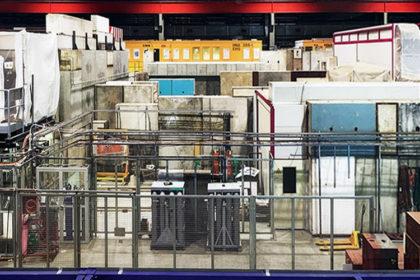
In the monochrome worlds of Nicolas Lado, humans appear as secondary figures, dwarfed by overwhelming natural and technological forces – like the sea or passing trains. Here, the idea of a human bond is expanded: the bond between two people is no more or less significant than that between a person and the sea, so long as one side is human.
Exhibition view
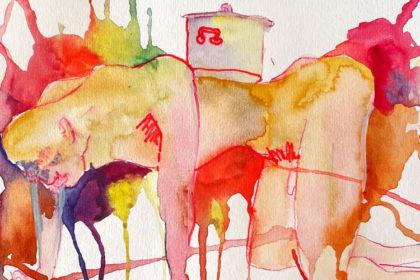
In her vivid and raw asemic works, Natalia Kungurova constructs a unique “dark” perception of human bonds, treating them as paradox, rupture, and inversion. In her aesthetic language, a bond arises at the fateful moment of first contact – only to gradually distort and collapse.
Natalia Kungurova. Unrealisable
Kutay Yavuz offers a view of people from behind, blurred and indistinct, merging into a backdrop of aggressive urban imagery: sexualised advertisements, massive balloons, and brooding overpasses. In this vision, people are bonded because they dissolve into the body of the city – equally hazy, equally faceless.
Julia Shilo’s work explores human connection as a fragile, intuitive force. Rooted in nostalgia, her layered figures – partially veiled by sheet music -reflect how meaning and emotion pass between people through silence, memory, and gesture, beyond words and time.
Kutay Yavuz. No Taboo
Among all the exhibited works, Juan Forgia’s video art stands apart – almost as if gathering the whole exhibition into a single process, marking its key accents while simultaneously evoking a strong impression of both coherence and fragmentation in the universe itself. Aesthetically and conceptually, this Argentinian-Italian artist’s video work draws from two opposing traditions: the self-critical, intellectually sharp Southern European video art of the 1970s and, on the other hand, contemporary advertising, spiritual online messaging, and avant-garde object theatre. His 1-minute-and-7-seconds piece Freedom leaves a lasting impact through its critical energy, visual aesthetics, dark humour, and the overwhelming presence of mute or hyper-mute objects. It appears to follow its own unspoken logic, and in engaging the viewer, begins to perform functions not usually associated with video art as a genre. For Forgia, the human bond is a meta-bond: an invisible fishing line threading together boredom, routine, ruins, clothes, people, trees, and houses somewhere in the background. He reveals this bond as a property of silence within a world saturated with voices.
Exhibition view
Author: Nata Yanchur, artist, curator, writer on contemporary art, co-founder of the CucumberMag
We use cookies to ensure that we give you the best experience on our website. If you continue to use this site we will assume that you are happy with it.